







PLANT-BASED COLOR: A new vision of makeup
Flowers on your skin
In conventional makeup, color comes primarily from synthetic or mineral pigments. Le Rouge Français has chosen a different approach: drawing color from the heart of plants. Derived from botanical dye plants such as madder and indigo, our plant-based pigments deliver intense shades while preserving certain compounds naturally present in the plants from which they are extracted.
BOTANICAL DYE PLANTS n. pl. — From the Latin tingere (“to dye, to color”). Plants naturally rich in coloring compounds, whose pigments are extracted from roots, leaves, flowers or bark to create plant-based dyes and colors.

THE POWER OF BOTANICAL DYE PLANTS
After three years of research, we developed a unique, patented process that allows us to extract and infuse both the coloring and biological properties of plants into cosmetic formulations.
Madder, annatto, sorghum, indigo, Damask rose and hibiscus are just some of the botanical sources that inspire us, whose pigments and natural biological properties we bring to light.
Our plants are harvested in their countries of origin to preserve their natural environments and uphold traditional cultivation practices passed down through generations.
And because these plants do more than simply provide color, our pigments also bring their natural benefits to the skin.
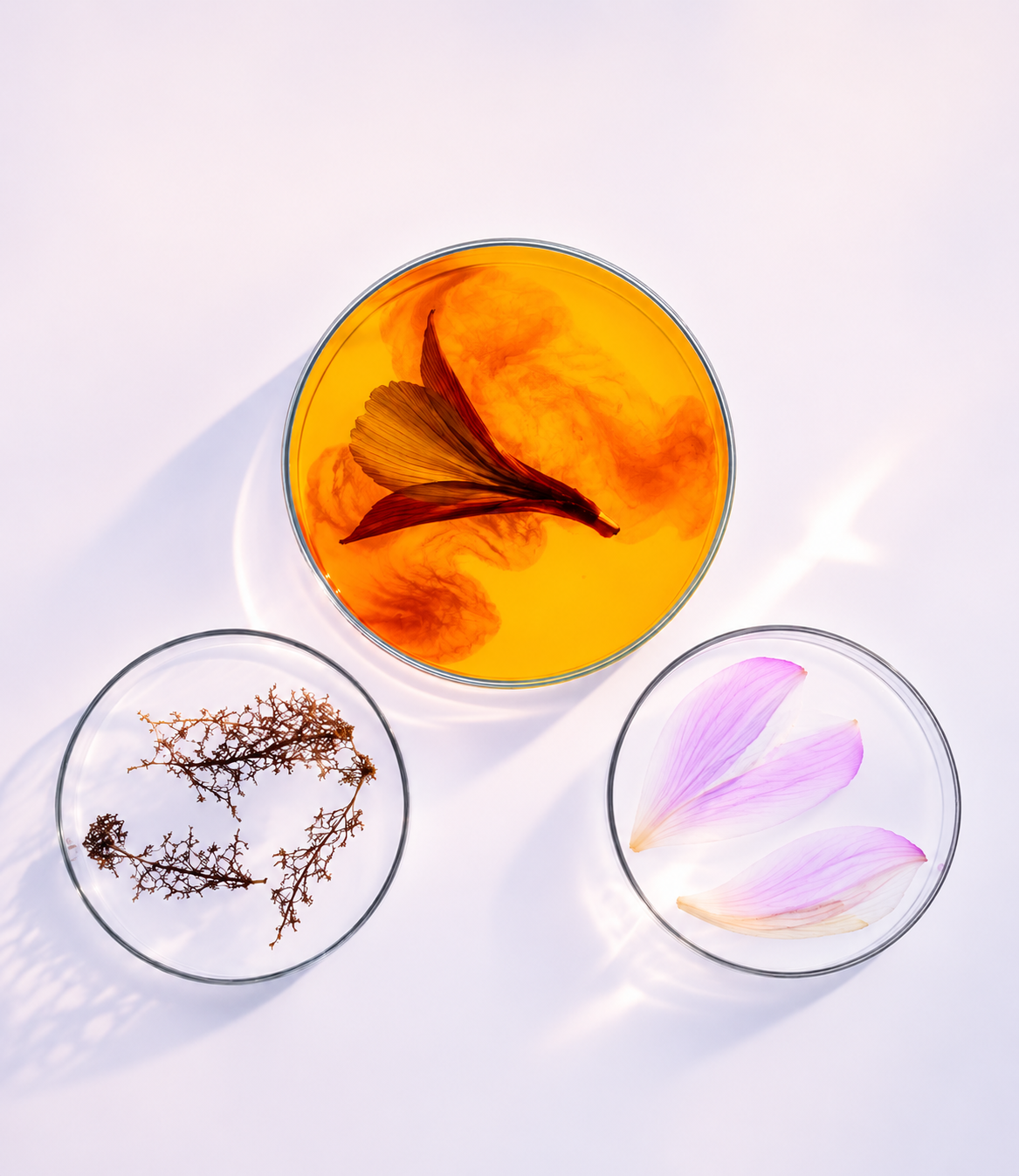
Our natural pigments
Every shade begins with a plant. From roots and flowers to bark, seeds and resins, discover the botanical ingredients that make up our plant-based color palette.

Red beetroot
Beta vulgaris L.
Red beetroot is rich in betacyanins, pigments ranging from red to purple. These compounds are also powerful antioxidants that help protect the skin against signs of aging.

Annatto
Bixa orellana L.
Considered sacred by many Amazonian civilizations, annatto is traditionally used as body paint. Its coloring properties come from bixin, the molecule responsible for the red color of annatto seeds.

Sappanwood
Caesalpinia sappan L.
Sappanwood belongs to the family of redwoods. Native to Asia, it has been used for thousands of years to dye fabrics a deep red.

Chestnut tree
Castanea sativa Mill
Chestnut tree bark produces a beautiful brown-beige pigment. From the 19th century onwards, interest in this tannin-rich tree grew due to its use in leather tanning and dyeing.

Cosmos
Cosmos sulphureus Cav.
Native to Latin America, cosmos was used by pre-Columbian civilizations as a source of yellow and orange dyes. Cosmos flowers are also edible.

Dragon’s blood
Croton lechleri Müll. Arg.
Since ancient times, this blood-red resin has been used both in medicine and as a dye. It also possesses healing and antioxidant properties.

Turmeric
Curcuma longa L.
Deeply rooted in Hindu culture, turmeric has been used for textile dyeing, body painting, as a spice and for medicinal purposes. Its dried and powdered roots produce a beautiful golden-yellow pigment.

Hibiscus
Hibiscus rosa-sinensis L.
In China and India, the juice extracted from hibiscus petals and flowers was traditionally used as a dye to darken eyebrows and hair. The national flower of Malaysia, hibiscus is still used in traditional Malaysian medicine today.

Indigo plant
Indigofera tinctoria L.
The leaves of the indigo plant contain indican, a precursor molecule of indigo. The shades obtained through plant-based dyeing range from black to a light blue known as “raven’s eye blue.”

Purple sweet potato
Ipomoea batatas (L.) Lam.
Purple sweet potato is rich in anthocyanins, which give it its distinctive purple color.

Sacred lotus
Nelumbo nucifera Gaertn.
A sacred flower in Eastern religions, the sacred lotus symbolizes elegance and purity. When ground into powder, its flowers produce a pinkish-beige pigment.

Bamboo charcoal
Bambusa sp.
Activated charcoal is obtained by burning bamboo branches, shoots and roots. It is a plant-based black pigment with detoxifying properties.

Alkanet
Alkanna tinctoria
Alkanet is a botanical dye plant whose powdered roots produce mahogany hues, warm undertones and violet shades.

Dyer’s rocket
Reseda luteola L.
Used for thousands of years, dyer’s rocket produces a pale yellow pigment. From the 1st to the 10th century, it was the main source of yellow, orange and green shades for Egyptian dyers.

Chinese sumac
Rhus semialata Murray
The galls harvested from Chinese sumac (Rhus semialata) are rich in gallotannins. When ground into powder, they produce a beautiful beige pigment.

Damask rose
Rosa x damascena Mill.
Revered since ancient times, the Damask rose is a symbol of womanhood and femininity. When ground into powder, its flowers produce a delicate dusty pink pigment with soothing and toning properties.

Madder
Rubia tinctorum L.
Red madder has been used for thousands of years, dating back to ancient Egypt, Rome and Greece. Its roots contain a wide variety of natural dye compounds.

Tomato
Solanum lycopersicum L.
Tomatoes contain the highest concentration of lycopene. In addition to its beautiful orange-red color, lycopene is a powerful antioxidant.

Sorghum
Sorghum bicolor (L.)
The dye extracted from the sheaths surrounding the sorghum stem was traditionally used to dye leather, cotton and rushes. It was also used for body painting and to color gourds and masks in southern Benin and Nigeria.