






Lipstick Components
A complex composition.
Focus on lipstick components: Do we ingest our lipstick?
The challenges of clean beauty
Scientific research into the elements contained in our beauty products is accumulating, all concluding on the presence of heavy metals, synthetic materials, petrochemical-derived substances, and products from overexploited or endangered animals. The composition of lipsticks proves even more problematic as they can be ingested and absorbed through mucous membranes. It is therefore legitimate to ask the following questions: are the ingredients in your stick, in addition to not being ethical and ecological, harmful to your health? Can alternatives be found? What do brands like Le Rouge Français offer in terms of clean beauty to face the contemporary challenges of makeup?
"Lipstick is a complex product that is subject to many expectations." Le Rouge Français
Lipstick: a product with demanding composition
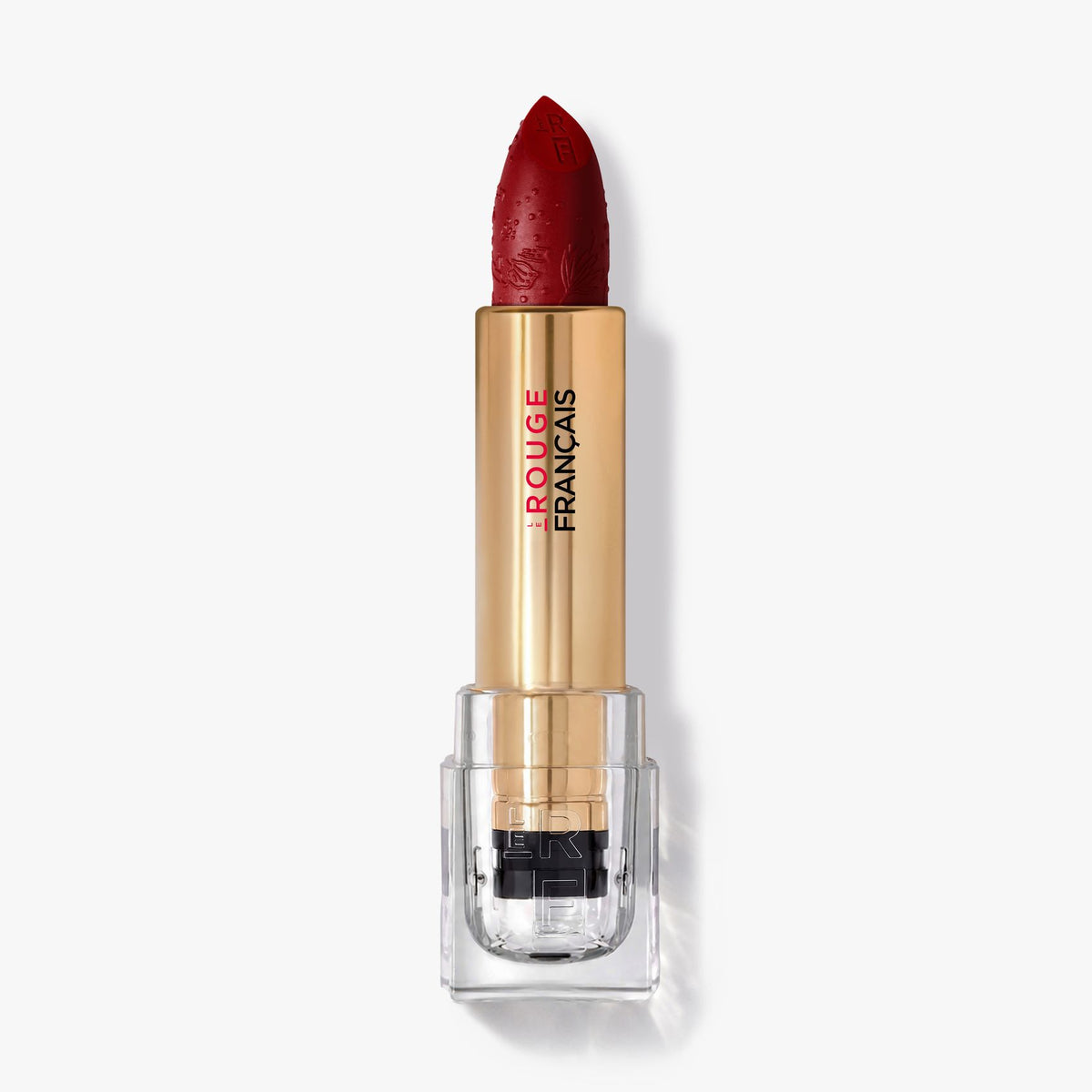
Despite its apparent simplicity, lipstick is a complex product that is subject to many expectations. Its color, of course, is at the center of attention. But we also look for a particular texture, whether shiny or matte. Let's add that it must be able to last as long as possible and that its scent must not be unpleasant. How do manufacturers create this precious little stick?
Waxes, oils, and butters
Fats are the main components of lipsticks. They exist in three forms: liquid, thick, or solid. Their origin is also diverse and can be animal, vegetable, or synthetic. The necessity of these fats lies in the fact that they give consistency to lipstick. Their mixture first allows the stick to hold its shape, even when it's hot. Then, despite its firmness, it must be easily and evenly spread. The ultimate goal for brands is to add a soft and silky finish. The dosage of ingredients, meanwhile, determines the desired texture. Thus, a higher percentage of oil provides transparency and shine; more butter gives a matte appearance.
Colorants
A wide range of colors must correspond to the variation of skin tones and the fluctuation of trends and desires. This generally extends from bluish red to orangey red. But contrary to its name, lipstick can also take on more unusual shades such as silver, gold, black, brown, etc. Color originates from various synthetic, mineral, animal, or vegetable pigments. Water-soluble colorants are not used for lipsticks because they do not adhere to the skin. However, it is possible to find additional glitter and mother-of-pearl derived from minerals, plastic, glass, or synthetically manufactured.
Fragrances
To mask the odor of other constituents, or to create a desire to apply lipstick, it is common to add fragrances. These are the result of a mixture of several essential or synthetic oils. Let's not forget that the first lipstick stick was sold by Guerlain, a renowned perfumer, from scented candle wax. Most of the time, the olfactory sensations evoke candies or confectionery such as violet, rose, or vanilla.
Other substances
In addition to the essential components, lipstick manufacturing formulas contain preservatives and antioxidants to prevent product deterioration by avoiding the proliferation of microbes. It is also possible to find vitamins or even UV filters.
The case of lip balms
Unlike lipsticks, the primary function of balms is to protect and soothe the lips rather than to beautify them. Their thin skin, which does not produce sebum, is indeed subject to many aggressions such as cold, wind, and dryness. Moreover, cold sores commonly develop there. Lip balms thus primarily serve to create a protective layer on the lips and maintain their hydration. The line between lipsticks and balms is sometimes thin. The latter can combine aesthetic and restorative aspects: they are then called treatment lipsticks. As for balms, they can incorporate light pigments.
Many harmful ingredients
4 kg of lipstick ingested per woman in a lifetime
All the elements we have just mentioned are therefore found on your lips. In addition to the fact that part of the content of your stick is absorbed by the skin, you also swallow it when eating or licking your lips. We estimate that approximately 30% of the material is ingested, which represents an average of 4 kg per woman in a lifetime. So, you might think that the components allowed in lipsticks are the same as those in food products? Unfortunately, this is far from the case.
Petrochemical products
The waxes used for lipstick sticks or the oils for conventional glosses most often come from hydrocarbons. They are divided into MOAH (mineral oil aromatic hydrocarbons) and MOSH (mineral oil saturated hydrocarbons). This is the case for fatty esters and paraffin. On labels, you may read the terms "synthetic wax", "microcrystalline wax", "polymer", "polyethylene", "paraffin", "ozokerite", "mineral oil", etc.
In addition to the pollution caused by petrochemical industry processes, the ingredients are potentially carcinogenic. Furthermore, they clog pores, increase bacteria, and are dangerous for the liver and lymphatic system.
Chemical components
Synthetic substances created from minerals or metals are numerous on the labels of our cosmetics, whether to obtain a better texture, good preservation, a sun filter, a pleasant fragrance, or a pretty color. However, many risks are associated with them, such as allergic reactions, endocrine disruption, cancer, irritation, etc. Let's add that the excess carried away by wastewater flows into rivers, streams, and the sea, and they prove toxic to aquatic organisms.
We can list, non-exhaustively, iron oxide nanoparticles, manganese phosphate, silicone oil, parabens, aluminum powder, titanium dioxide, zinc oxide, phenoxyethanol, bismuth oxychloride, azo dyes such as tartrazine, or BHA and BHT.
Finally, heavy metals such as lead, cadmium, or manganese are detected in some lipsticks. The problem lies in the fact that they are carcinogenic, harmful to the kidneys and the nervous system, and can cause pain, fatigue, or dizziness. Children and pregnant women are particularly exposed, hence the importance of paying attention to the labels.
Animal substances
Certain animal fats are present in the preparation of lipsticks. While whale fat is now banned, we can still find shark liver oil. The use of the latter, called squalene, leads to overfishing of sharks, even though some species are threatened with extinction.
When cosmetics do not contain animal substances, they can nevertheless be tested on rats, mice, or rabbits in certain supply chains, despite the ban in France and the European Union.
As for so-called natural lipsticks, be aware that they are not free of animal products or allergens. This is for example the case of sticks containing lanolin, which are derived from the fatty alcohols of sheep's suint.
The necessity of clean beauty
Given this enumeration, you are probably wondering if it is possible to find a lipstick that is not harmful to your health. Are brands that offer organic, natural, responsible, clean makeup reliable?
Organic makeup products
Manufacturers use many terms to make you understand that your health and the ecological impact of their products are at the center of their concerns. How to know the validity of the arguments put forward? Let's define and analyze them.
An organic lipstick means that it is made of natural elements, that is, minimally processed. Moreover, organic farming ingredients come from crops that do not receive pesticides and chemical fertilizers.
Several labels exist to certify the absence of toxic substances and processes, such as Ecocert, Cosmébio, or Nature et Progrès. Some are more restrictive than others in the percentage of natural components or in the number of those to be banned.
However, be careful with the "natural" stamp. It guarantees nothing if it is not accompanied by a label logo. Some brands simply change their commercial techniques to improve their image by practicing greenwashing.
In addition, some minimally processed ingredients can still be allergenic. They are then mentioned on the packaging above a certain threshold. This is the case for lanolin and several essential oils.
To help you find the rare gem when shopping in store or online, associations like UFC-Que Choisir or laboratories have created applications such as Yuka, QuelCosmetic or Clean Beauty. You have the option to scan or photograph the lipstick or its barcode and identify any undesirable ingredients.
Vegan and cruelty-free lipsticks
Organic does not mean vegan or cruelty-free and vice versa. If you do not wish to participate in animal experimentation, their exploitation for cosmetic purposes, or ingest them, you can rely on different labels.
However, the term "vegan" is not regulated. Consequently, some brands may create their own certification without buyers truly knowing what to expect. This designation may only mean that the product contains no ingredients of animal origin. This applies to meat and fish, but also to milk, honey, or eggs, which come from animals. But it does not necessarily exclude experimentation on them.
To be sure that your lipstick does not contain animal extracts or that it does not come from countries that systematically test their products on rats, mice, or rabbits, you can rely on the V-label, Vegan Society, Eve Vegan, or Certified Vegan labels.
Organic and vegan lipsticks from Le Rouge Français
Given current scientific knowledge about the effects of lipstick compounds on health and the environment, we must act. This is why Le Rouge Français has developed cosmetic formulas that respect all living things.
The revolution of pigment through dye plants
To develop virtuous and eco-responsible lipsticks, this cosmetic house has returned to the source of coloring through plant pigments. If the makeup industry has started using chemical substances, it is because they allow better hold, long preservation, a wider range of colors, and at a lower cost. Le Rouge Français therefore had to implement several trials to develop quality formulas.
The numerous and meticulous researches of its founder, a biotechnology engineer, have made possible the discovery of suitable dye plants, the extraction of their pigments, and the stabilization of colors. This expertise and its innovative approach are recognized by patent filings and by their distinction in the Cosm’Ethique 2019 competition of Cosmebio. Furthermore, the brand holds the Ecocert, Cosmos Organic, cruelty-free and vegan, and Made in France labels.
Total control of the production chain
The journey of Le Rouge Français lipsticks begins in the laboratories and research center located near Marseille.
The raw material, meanwhile, comes from French, European, and non-European harvests. To obtain a healthy and ethical result, the startup opts exclusively for plants derived from organic farming. Moreover, it favors endemic plants, meaning those that grow spontaneously in their geographical area. Indeed, they strengthen the genetic heritage of a region, are more resistant, and thus require fewer protections against diseases or insects. Examples include madder, sappan, hibiscus, or annatto.
While dye plants have been used for millennia, today we use technology to effectively extract pigments from each plant. As for manufacturing, which takes place in Normandy, Le Rouge français only uses vegetable waxes from rice, candelilla, and carnauba. Their lipsticks contain neither titanium dioxide nor any other generally toxic chemical element.
Finally, they carefully select their points of sale by verifying their ethics. Do not hesitate to take the plunge towards the makeup of tomorrow: organic, natural, vegan, and… plant-based!
Read more

If there's one element cosmetic manufacturers focus on, it's color. Smoky eyes, carmine or vermilion lips, nude or pop styles: there's something for all tastes and all occasions. However, do brands...

How did people do their makeup in antiquity? Are there still traces of these practices in our beauty routines? Do women around the world have the same perception of makeup? Do they use the same pro...